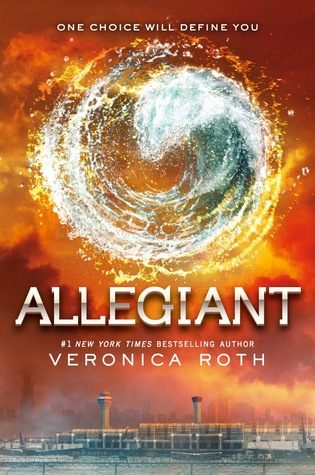
(Spoilers ahead for those who care.)
After the events of Insurgent, where the factionless overthrew the city government and took control, Tris and Tobias decide to follow the directions left in a cryptic message, and, along with several others, escape the city to go looking for the people outside its walls. It turns out that the city and its faction system was all part of a grand experiment, designed to create a race with purer genes (known to the city-folk as the Divergent). Of course, there are rebels who don't agree with the experiment and attack the scientists, and Tris and Tobias find themselves caught between the rebels, the scientists, and their family and friends still in the city.
Like the previous books, Allegiant was written in first person, but for this book, the author chose to switch at every chapter break between Tris and Tobias, rather than just having Tris tell the story. While this was probably a necessary move due to the more complicated plot, it was practically impossible to tell who was speaking unless you payed close attention to the chapter headers. This was particularly frustrating because Tris and Tobias were set up as characters with very different back stories, motivations, and ways of thinking. It should have been easy to tell whose head you were inside, but the author just wasn't that good at giving her characters different voices, and the perspective switches made that abundantly clear.
I also came away confused as to what the point of the book was supposed to be. Was it a story about love? Was it about finding your way when your world is turned upside down? Was it about the inherent value of human lives, regardless of genetic makeup? Or maybe about the dangers of valuing science above humanity? You could make a case for all of the above, given how the book jumped around. While the plot did move steadily forward, the author jumped back and forth between emphasizing each of the points above, and none of them ended up feeling fully developed. I was just reading an article the other day about the dangers of trying to expand your focus too much when writing sequels, and it seems to me that this is exactly what happened with Allegiant.
So was it a good book? Yes and no. It did raise some interesting questions, but the quality of the story-telling was not great. If you're really into young adult dystopian novels and an interesting plot is more important to you than well-developed characters and themes, you'll probably enjoy it quite a lot. But if that's not really your thing, then you're probably better off spending your time on something else.
